


It’s been seven days since my daughter left home.
Seven days of walking past her empty room and still catching myself listening for her key to unlock the back door. Seven days of a strangely clean kitchen and quiet mornings that feel slightly hollow.
Yes, I miss her. Deeply.
But what I didn’t expect was how piercingly the silence would bring something else into focus—something I’d carried so long, I’d mistaken it for normal.
I couldn’t name it right away. But once the volume faded, there was a strange kind of lift or release—like stepping out of a room I didn’t know was loud.
Yes, I have more time. But more than that, I have a depth of bandwidth that feels… stunningly foreign.
I start tasks without rushing.
I think thoughts all the way through.
I plan and prepare meals without holding space for a half dozen last-minute changes or alternate endings.
That low-grade pressure—the constant scanning for what might come up—is gone.
And in its place is stillness. Not the lonely kind. The kind that doesn’t ask anything from you. The kind that feels like a long, slow, desperately needed exhale.
But this isn’t a piece about becoming an empty nester.
It’s a signal flare from someone just now feeling what it’s like to come up for air.
Because even though we carry it—acutely, constantly—we don’t always see what it’s doing to us.
It becomes the water we’re swimming in.
And when something is that close, it’s hard to name, let alone release.
The Invisible Load Is a System
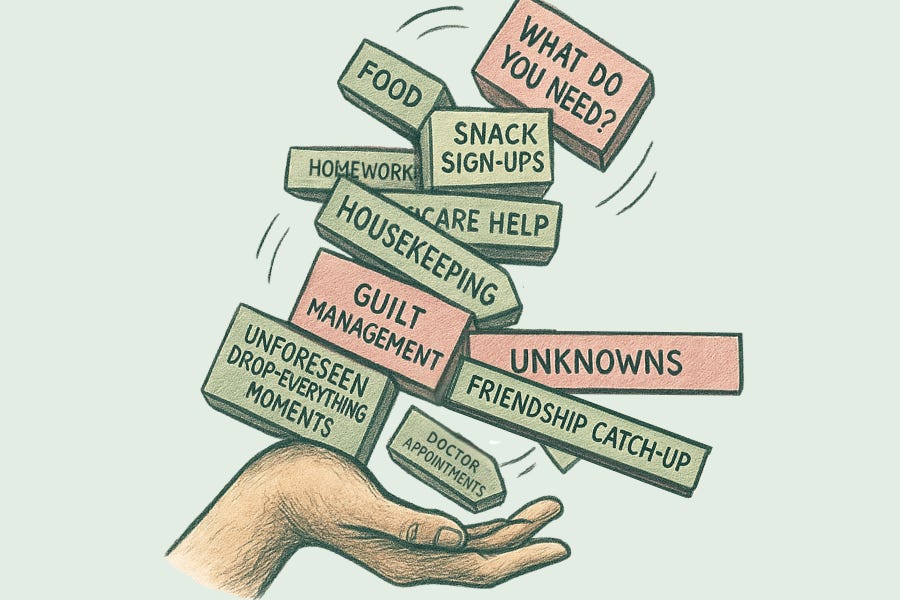
We talk about the mental load of parenting like it’s a pile of tasks—the grocery list, the permission slips, the “Did you remember to…?” at 10 p.m.
But it’s not just a to-do list.
It’s a system of alertness—constant micro-adjustments, surveillance, and self-correction.
We’re not just making dinner.
We’re assessing mood, gauging appetite, estimating time, troubleshooting a conversation—all while preparing to transition into homework help or bedtime negotiations.
It’s not just what we’re doing.
It’s what we’re bracing for.
And when that becomes our baseline, we stop noticing how clenched we’ve become—physically, mentally, emotionally—just to make it all work.
We don’t sign up to carry it all at once.
We accumulate it—bit by bit, choice by choice—until what once felt optional becomes unquestioned.
We take it on quietly: the appointments, the commitments, the keeping tabs.
Because we’re good at it.
Because it’s faster.
Because someone has to.
Eventually, it stops feeling like a choice and becomes the standard—an unspoken pressure to maintain what no one else even sees. And because it looks like every other “good parent” is doing it all, we convince ourselves we can’t be the one to step back. That’s when the message starts to sink in—living at the edge of ourselves isn’t a problem to solve, it’s just part of the job.
Without realizing it, we build a life around an unspoken agreement to hold it all or risk something breaking.
We tell ourselves if we don’t, things will fall through the cracks.
That our kids will miss out.
Fall behind.
That we’ll be the weak link.
Somewhere in there, we stop asking if any of it is necessary — or if we’re slowly disappearing under its weight.
And that’s where the real cost begins.
Useful. Capable. Disappearing.
The mental load doesn’t just ask for our energy; it steals our self-permission.
We stop asking:
Do I want to do this?
Do I have the capacity?
Does this even matter to me?
And start asking:
What will people think if I say no?
Will I seem selfish or lazy or disengaged?
If I let something drop, does that mean I’ve failed?
Sometimes, we keep doing it—simply because we always have.
Over time, we start measuring our worth by our usefulness. We become a composite of other people’s expectations — and our internal direction goes dormant.
I remember saying yes to something so small it shouldn’t have mattered—a quick errand, a simple favor. But I got in the car and cried the whole way there. Not because of what I agreed to. But because it was the 47th yes in a week I only had six to give.
That’s what happens when our selves go quiet for too long.
We stop making choices based on the value they add, and start making them based on who might be disappointed if we don’t.
Until one day we’re in the grocery aisle, crying over oat milk because it’s disgusting it’s the first time all day no one else’s voice is in our head, and in the silence, we realize: ours isn’t there either.
When we forget what our own voice sounds like, even the smallest decision feels performative and shallow. Like we’re just trying to get it “right” instead of choosing what’s real.
The Mental Load Isn’t Evenly Distributed—and It’s Not Just About Gender
We tend to frame the mental load around gender roles, and that’s real.
But underneath is something deeper: who’s allowed to default to rest? And who feels obligated to keep scanning the horizon?
In many homes, the split isn’t 50/50—not because anyone meant for it to be that way, but because one person has been conditioned—by habit, history, or unspoken expectation—to carry the invisible things before anyone else notices they exist.
The tracking.
The anticipating.
The remembering.
The what-ifs and just-in-cases.
The emotional infrastructure that keeps everyone else functioning.
Sometimes it’s driven by temperament. Or birth order. Or childhood wiring.
Sometimes the “carrier” is the one best at holding it all—until they can’t.
For many of us, we internalize early that our value (or safety) lies in being one step ahead.
We anticipate other people’s needs before they’re named.
We over-function in silence, in rooms where no one asked us to.
We proofread the family’s emotional weather forecast before deciding how we’re allowed to feel.
Even when we’re supported.
Even when we’re partnered.
Even when no one’s explicitly asking us to carry all of this.
We still do it.
Because somewhere along the way, vigilance started to feel like love. And letting go now feels like neglect.
But what begins as caretaking slowly becomes something else:
A self-erasing.
A performance of strength so seamless, no one thinks to ask if we’re breaking.
And meanwhile, our kids are watching—not just what we do for them, but what we never do for ourselves.
The Emotional Fallout
When we live this way long enough, we forget there’s even a difference between stress and identity. Between burnout and normal.
We don’t just become tired.
We become resentful.
But the resentment has nowhere to go, because it feels aimed at people we love. So we turn it inward.
We wonder why we’re not enjoying our kids more.
We label ourselves selfish.
We feel guilt for wanting space.
Shame for feeling reactive.
We scroll past burnout memes and laugh in recognition, but deep down there’s a grief forming:
We’re present for everything—except ourselves.
Awake for all of it, but losing access to any of it.
And our kids are absorbing it. Our words. Our schedules. Our pace.
They’re learning what life should look and feel like.
How much space they’re allowed to take up.
What love requires.
What adulthood costs.
But the version we’re teaching is skewed. Because we’ve added so much static—noise, unnecessary shoulds—our kids aren’t seeing how to love life or connect with one another. They’re seeing how to endure it.
Not because we’ve failed.
But because we’ve been swimming in this so long, we stopped questioning the water.
We cannot keep going like this and call it “normal.”
We can’t keep handing our kids a life that shows love and adulthood are defined by exhaustion.
We don’t need more. We need less of so much.
Something has to give.
Permission to stop performing what can’t be sustained.
To question the system instead of just tweaking the calendar.
To change the pace instead of shoving obligations into a space that isn’t there.
Because today, when someone asks, “What can I do?” it’s not relief we feel. It’s a sharp kind of frustration.
Because what we want—what we really want—is for the entire framework of our lives to shift. Not just help with the demands, but freedom from the assumption that we can (and should) hold all of it without bracing.
But how do we say that without sounding ungrateful?
How do you tell someone, “I don’t need a break — I need to rebuild my life from the ground up”?
Scorched Earth Isn’t Dramatic—It’s Necessary
So here’s the part I used to soften, but won’t anymore:
We don’t fix this by organizing better or wedging in ten minutes of self-care.
We fix it by stopping.
Not pausing. Not recalibrating. Stopping.
Strip the calendar to the studs—until our days feel almost empty, unsettlingly so.
That’s where we finally hear ourselves again.
Cut every commitment that isn’t essential to physical or emotional safety and well-being.
Say no without explanation.
Say yes only when our body doesn’t tense.
Live boring.
Live quiet.
Live unimpressive.
Not forever—just long enough to start over, with honesty this time.
Because if we don’t, we normalize depletion as devotion—and teach our kids that exhaustion and discontentment are essential parts of loving well.
We don’t clear the decks because we’re fragile.
We clear them because we’re finally wise enough to stop proving we’re not.
And little by little, our focus shifts—away from what we produce or how seamlessly we manage the chaos, toward how we feel when we wake up, how often we laugh, how much space we make for wonder, rest, and a presence that isn’t staged.
We stop building a life to manage crisis—and start building one to hold meaning.
To hold joy.
To hold us—fully, without asking us to shrink.
When we stop saying yes to everything, we don’t just free up time—we free ourselves.
The pressure eases.
The hum quiets.
In the space that’s left, we notice our own wants again—not the ones shaped by obligation, but the ones we forgot existed.
And that clarity feels a lot like relief.
But if you choose this path, know this: what comes next isn’t applause—it’s resistance. And it must be met with an enormous amount of courage.
People won’t get it.
We’ll be called radical. Too removed. Unreliable. Changed.
We’ll lose favor and status—and a few friendships built on availability, not well-being.
There’s a decent chance we’ll be wildly unpopular.
But what we gain is priceless:
Access to ourselves.
Lightness.
Discernment.
Attunement with our internal compass. Alignment with our values.
And the capacity to envision and contribute meaningfully to the life we’re building—instead of just maintaining a version not our own.
And maybe most importantly, our kids will witness what it looks like when a person refuses to disappear inside a role.
What if this was the moment you lightened your load?
If this hits home and you’re ready to make some changes, The Invisible Load Reset: A Practical Guide for Parents to Reclaim Their Bandwidth is now available for paid subscribers.
It’s a step-by-step guide to help you name what you’re carrying, sort what matters, and rebuild your rhythms around what truly restores and energizes you.
Upgrade now to get instant access.
This Is Your Permission Slip
So if you’re in it right now—spinning, over-functioning, quietly unraveling—let this be your permission slip.
You’re not broken.
You’re at capacity.
That’s not a personal failing—it’s a flare.
I don’t spend much time in regret. And I’ve gotten pretty skilled at saying no these last few years. But if I’m honest—if I could go back knowing what I know today, after just seven days of stillness—I’d scale back even more.
Not because I couldn’t handle it, but because I finally see what it was costing me to keep handling it.
A life built on depletion isn’t sustainable.
But it is rebuildable.
And every time we stop—every time we cut what drains us and guard what restores us—we tell a different story.
To ourselves.
And to the people watching.
Say no.
Say less.
Say “I need less…,” and let it stand.
Not because you’re falling apart.
But because you’re done disappearing.
Your kids don’t need a parent who holds it all. They need one who knows how to come home to themselves.
And maybe for the first time, you’re ready to stop surviving your life and start inhabiting it.
If you need this reminder again down the line—DM me, tag me in a comment—I’ll say it as many times as you need.
You’re allowed. And I’ll tell you you’re allowed as many times as you need to hear it.
The idea of "stopping" instead of just recalibrating or organizing better resonated so deeply. It's like you articulated that quiet, desperate whisper many of us have been trying to ignore. We've been told for so long that the solution to overwhelm is better time management or a new planner, but what if the real problem isn't our inefficiency, but the sheer volume of "shoulds" we've internalized? It feels almost revolutionary to hear someone say, "Strip the calendar to the studs." Thank you for the permission to consider a more radical approach, one that actually gets to the root of the exhaustion rather than just band-aiding the symptoms.
It's funny, I was just thinking about how we often mistake constant motion for progress, and how that can lead us so far off course from what truly nourishes us. This piece is a powerful reminder that sometimes, the most productive thing we can do is nothing at all. It's about reclaiming that internal space that gets swallowed whole by the relentless demands of modern life.
Trying to get out of lifelong burnout with a toddler sounds impossible tbh. But I resonated with a lot of this piece, thanks for writing. 💕