


Yesterday, I received a text from my youngest, Scout, who is 18 and away at college:
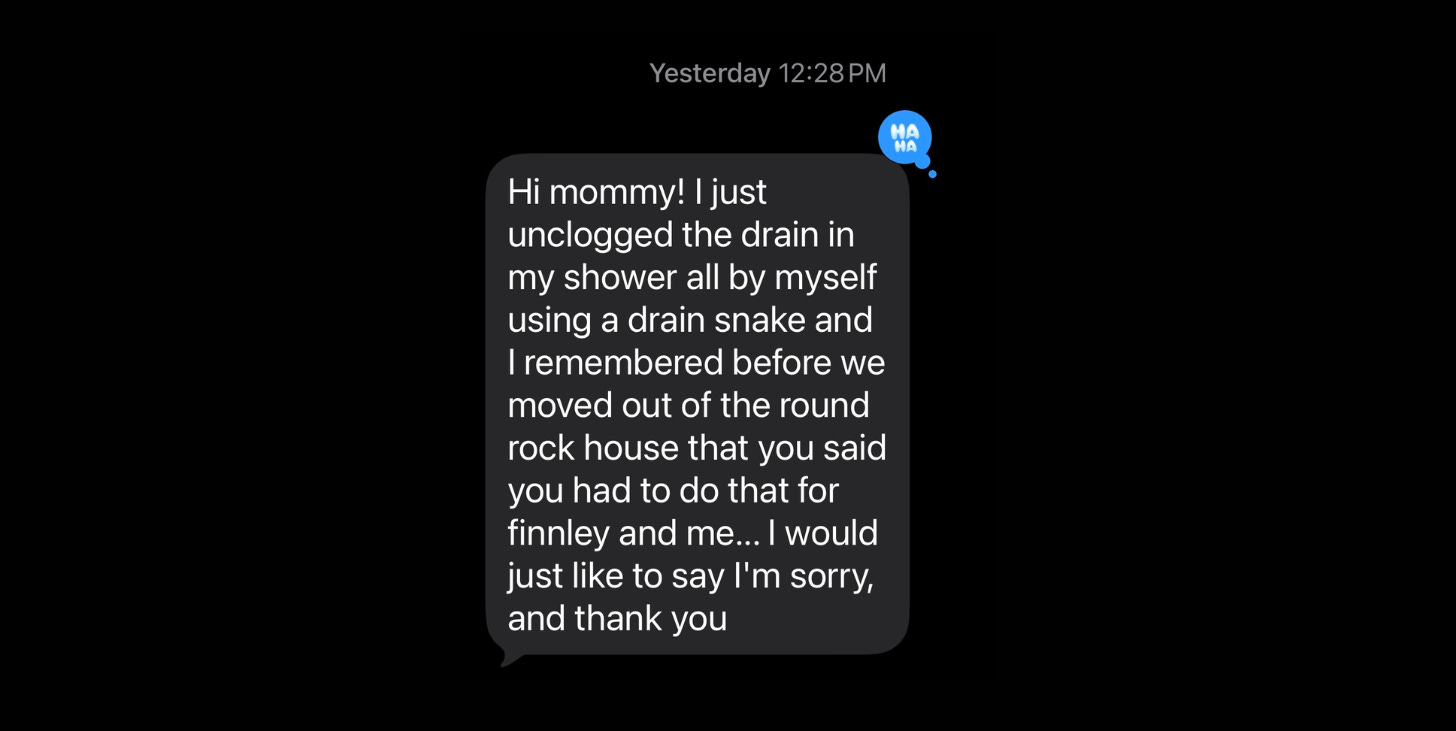
There are few parenting moments more surprising—or more moving—than being thanked years later for something your kid once barely noticed.
And it reminded me of something parenting has slowly, and not always gently, taught me: despite how much of parenthood suggests otherwise, we are not the great teacher in our kids’ lives.
Life is.
That can sound, at first, like a demotion, especially to those of us who care deeply about parenting well. We know what matters, and we know how much can go wrong.
We’ve lived enough life to see what is coming long before our kids do, and naturally, we want to help. We want to get there first with our warning, our explanation, our well-timed kitchen speech. We try to spare them the slower, more painstaking way most understanding usually arrives.
What we’re trying to help our kids see matters. But we are often trying to do a job that doesn’t belong to us. We can point toward an understanding, model it, and name it. But we can rarely make it land on command, no matter how clearly we see it coming.
A lot of what our kids eventually understand only becomes real to them when life makes it personal.
That’s not failure. That’s how learning works.
So often, we forget this because parenting feels so urgent. Childhood is long, but the days can feel oddly high-stakes. There is always something to address, correct, or stay ahead of: a mess to clean up, a tone to discuss, a habit to improve, a life skill to teach.
And because we love our kids, we become determined to squeeze meaning out of every moment. But not every moment demands that from us.
Sometimes a clogged drain is just a clogged drain.
Until five years later, when it isn’t.
Real learning usually comes down to timing. Someone can tell us something true long before we’re able to use it. It stays abstract until life makes it matter. Then one day, it’s no longer advice. It’s understanding.
That’s why our kids can hear the same thing from us ten times, shrug each time, and then come back later acting as though they’ve stumbled onto something entirely new. In a sense, they have.
We can tell our kids that little problems grow when we ignore them. We can explain cause and effect. We can mention maintenance and give lectures on learning to do unpleasant things before they become disgusting. Still, none of that carries quite the same force as standing ankle-deep in shower water holding a drain snake and realizing, with sudden clarity, that your mother wasn’t making it up. She was responding to a real problem long before it became real to you.
That’s the kind of learning that sticks, not because we finally said it the right way—or said anything at all, but because experience gave it shape.
This is where parenting can get a little lighter, if we let it. What our kids need from us isn’t constant commentary or instruction. They need a place to bring what life is teaching them.
And that can require a real shift in us, because the kind of guidance that helps at six may not help much at fourteen. By nineteen, the same instinct can feel less like care and more like crowding.
Often, the signal isn’t open rebellion. It is subtler than that. They start offering less: less detail, less honesty, less access to the unfinished part of what they’re going through. When every hard thing becomes a talk, kids learn to wait until they have already processed it themselves, or to say nothing at all.
What they usually need is room to be annoyed, to try, to figure it out, and to connect the dots without us drawing the conclusion for them in thick black marker.
Kids come back to people who let them be unfinished—to people who can tolerate a little mess, acknowledge the difference between danger and discomfort, and resist treating every struggle like evidence of failure.
Most parents aren’t trying to matter less. We want our kids, whether they are seven or seventeen or twenty-seven, to keep bringing us their lives. And one of the best ways to protect that closeness is to stop insisting on being the voice that always gets to name what things mean.
Some things can only become clear through lived experience. Our job isn’t to rush our kids past that process. It is to show them how to meet life well when it arrives.
And that begins with how we meet life ourselves.
Our kids are always studying our posture, even when they seem deeply committed to ignoring our words. They’re watching how we handle frustration, curiosity, challenge, disappointment, mistakes, and the ordinary demands of being a person.
We are showing them what it looks like to live as a person among other people, with limitations and responsibilities, and the occasional revolting drain.
That kind of teaching often bears fruit later. The real reward comes when our kids bring it back to us.
When the stars align and something finally hits home, we get to laugh with them, hear the story, receive the text, and enjoy the late recognition for the belated gift it is.
And when the stars don’t align—when life teaches through embarrassment or regret or disappointment or pain—we get to be the place they return to then, too. Not to erase what happened or rescue them from every consequence, but to help them come through it.
Sometimes this means letting inconvenience do its job. Sometimes it’s helping them clean up a mess without turning it into a character indictment, or listening long enough to ask a better question. Usually, it’s simply refusing to panic over a problem that falls well within the normal work of becoming a person.
Every now and then, it means receiving a sweet, slightly cheeky apology for years of shower hair and resisting the urge to remind them we’ve been saying this all along.
Because the goal is not to win the moment.
The goal is to raise people who can function from the inside out, who know themselves, face reality, take responsibility, notice what needs doing, recover from mistakes, and contribute to the lives and communities they are part of.
And if we can embrace that, parenting gets lighter in the best way. Not careless. Not hands-off. Just less burdened by the fantasy that everything depends on whether we say exactly the right thing before our kid struggles, misjudges, or learns something later than we hoped.
Life is always going to get its say.
That is not bad news. It’s mercy. Maybe even relief.
When our relationship isn’t overrun by instruction or correction, our kids want to come back and bring their lives with them. That may be one of the greatest joys of parenting on the other side of the most intense years. Not that our kids finally admit we were right, though that is admittedly fun. It’s that they let us witness who they are becoming.
My daughter had an ordinary adult moment and instinctively reached back toward home.
We don’t have to be the sole teacher. Life will do plenty of the work for us. Our role is to live well, help without taking over, and stay close enough that when life finally gets through, they still want to bring it home to us:
I get it now. And more importantly: I wanted to tell you.
Loved this.
And I'm sure you'll be receiving many more messages from me similar to that one in the near future. Thanks for always being the home I can come back to.