


I'm feeling contemplative these days.
My youngest is weeks away from heading off to college, and I can't help but reflect on what's worked well, where I've gone off track, and the immeasurable gifts I’ve received as a parent.
Lately, when I think back on the moments I wish I’d handled differently, something else surfaces just as quickly: the grace my daughters have repeatedly shown me. Not occasionally or when I deserved it—but consistently, instinctively, as their default.
While I was busy attempting to cultivate patience and empathy, they were already modeling it for me.
And it's got me thinking about how often we see our relationship with our kids as one-sided. How we mindlessly overlook the moments our kids offer us compassion, while we nitpick, correct, or grasp onto their mistakes.
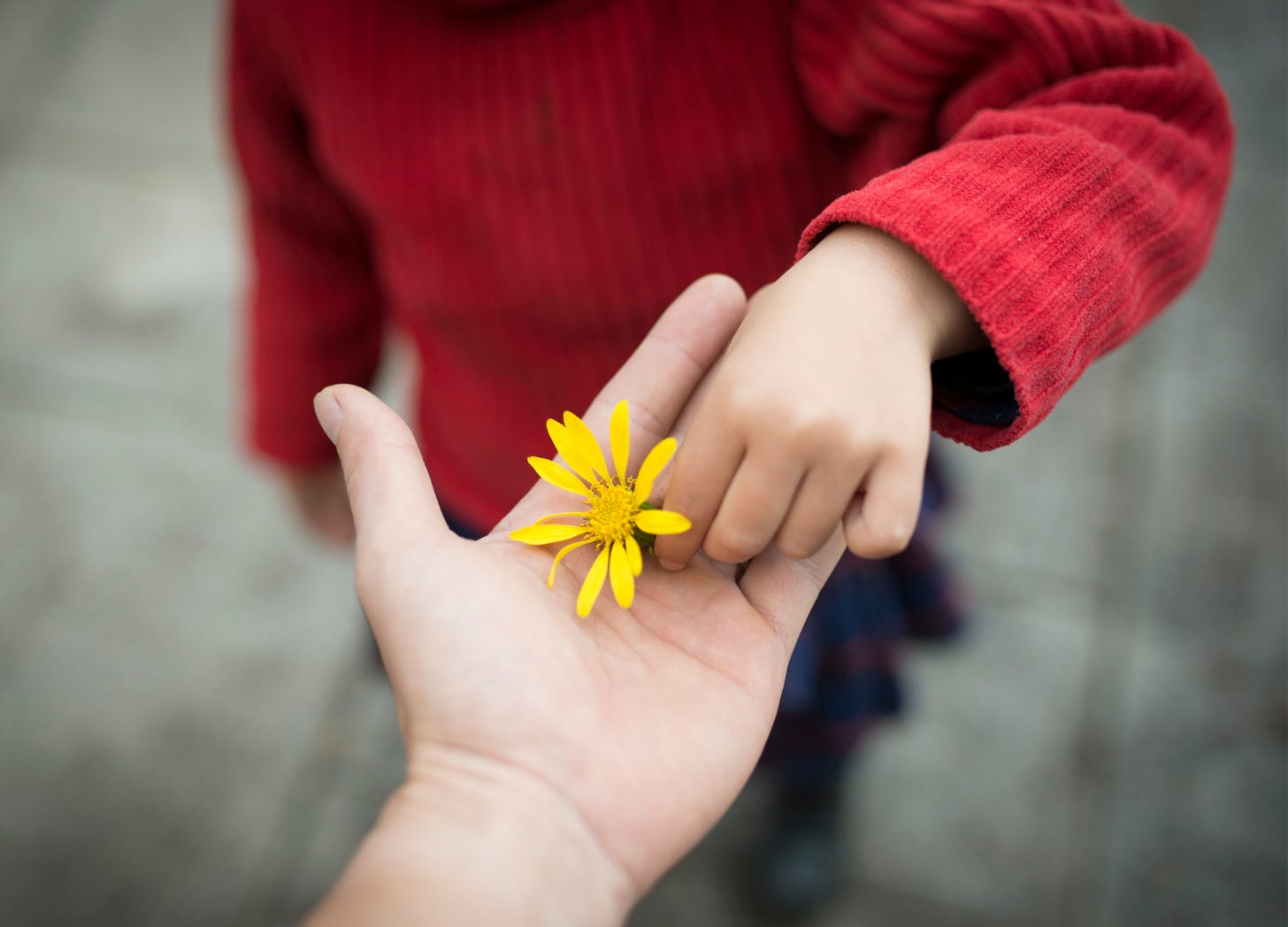
But what about the kindness our kids extend to us—every single day?
When we snap over lost keys, they help us search.
When we scroll as they tell their stories, they wait or begin again.
When we forget a promise, they simply ask once more, not to shame us, but to stay connected.
When our tempers flare for reasons that have nothing to do with them, they take it—gently—without retreating or pushing back.
They don't highlight it.
They don't keep score.
They just… offer it. Again and again.
While we're busy focusing on their attitudes, their compliance, their need for correction, they're softly practicing the very attitudes we're trying to foster.
And we're missing it entirely.
Maybe we don’t see their graciousness because no one ever taught us to look for it.
Parents are praised for being firm, consistent, in control. But rarely are we encouraged to be accountable—or to admit when our children rise to the moment better than we do.
We're conditioned to think of parenting as a role rooted in authority: we guide, they follow. We teach, they learn. But when that mindset becomes too rigid, we start to see ourselves as the sole givers, and our children as the ones always in need of refinement and growth.
Receiving grace from our kids doesn’t fit neatly into that framework.
It disrupts the hierarchy.
It forces us to confront a surprising, even uncomfortable, source of humility.
And unless we’re willing to acknowledge what they so freely give, we’ll keep missing the tender ways they already embody what we’re trying to instill.
Worse than missing it—we're often withholding the same understanding in return.
Sure, there are the obvious ways we lack patience with our kids.
The times we explode over spilled milk or homework battles, when we know we're being unreasonable but can't seem to stop ourselves.
But there are subtler ways the imbalance grows.
The ones we barely register.
When they ask for help at the wrong time, our tone tells them they’re a problem, not a person in need.
When they repeat a mistake, we see defiance, not growth.
When they don’t respond right away, lost in their own world, we call it disrespect instead of remembering what it means to be fully absorbed.
And so the imbalance is born—and perpetuated.
These moments add up. And in each one, our children offer us mercy we don’t return.
When our kids’ grace goes unacknowledged—or unreciprocated—something shifts.
What began as generosity slowly becomes their unspoken role.
Their kindness is taken for granted.
Their understanding absorbed without reflection.
They begin to believe it’s their job to smooth things over—even when no one is holding space for them. Not out of fear, but out of habit. Out of the belief that giving without getting is part of being loved.
And while they don’t stop loving us, they start to wonder if their needs are too much for others to bear.
They hesitate to ask for help.
They choose silence over closeness.
They become fluent in forgiveness, but unsure if they’re allowed to have weaknesses, too.
And in that faint, one-way offering, the distance between parent and child slowly grows.
But something shifts when we begin to notice the grace our children offer—and name it out loud.
The gesture is small. The transformation is profound.
"Thank you for waiting while I finished that call."
"I was short with you this morning, and that wasn't fair. You stayed calm and kind anyway, and I want you to know I noticed."
"You could have pushed back about bedtime, but you didn't. I noticed, and I'm grateful."
But noticing and naming are only the beginning. Because once we start to see what our kids are offering—really see it—we can choose to meet it. Match it. Return it.
We reshape the relationship into something more mutual and emotionally honest. A connection where both people feel safe to be imperfect. Where consideration isn't one-sided, but shared. Offered. Returned.
And as that shift takes root, it changes us, too.
It softens us.
We begin to listen more. React less.
Patience stops being something we muster and becomes something we embody.
We grow more human alongside our children.
And from that foundation, we raise kids who don’t just offer compassion—they expect it.
Kids who know love doesn’t hinge on flawless behavior.
Who trust that being human means sometimes falling short—and still being held.
They move through the world like they belong. Not because they never mess up, but because they know mistakes don’t cost you love.
Our children don’t just need our grace.
They deserve our recognition of theirs.
If we’re brave enough to see what our kids have been offering all along, we can stop parenting from a pedestal—and start parenting in relationship.
YESSS, Erin!!! ❤️
Beautiful piece, thank you for it.