


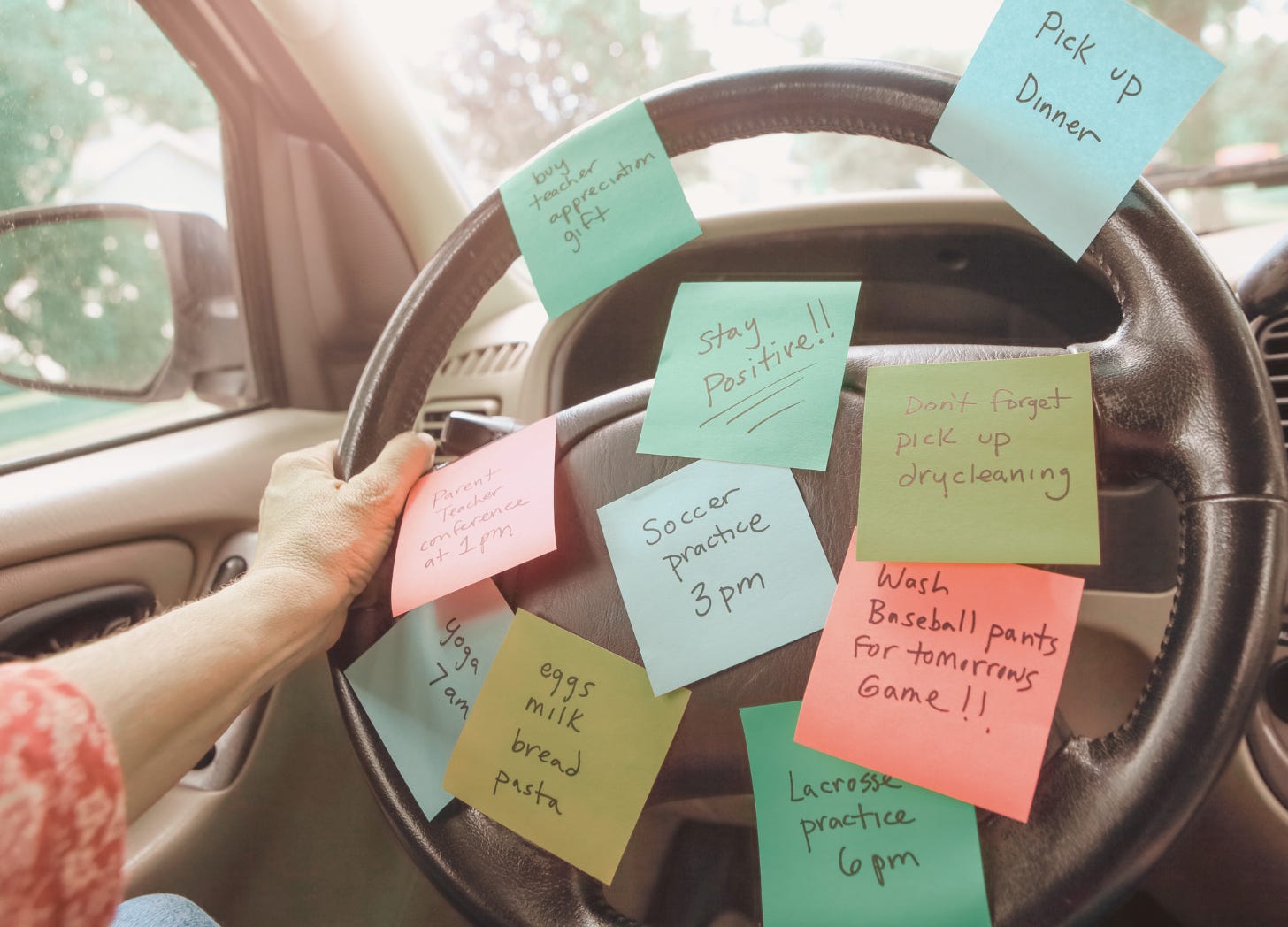
We spend years doing everything for our kids. In the beginning, that’s exactly what’s needed.
But almost without noticing, we cross a line. Reminders pile up. Invisible labor expands. The weight of everyone’s moods becomes ours to hold. And we start to wonder: why does this feel so heavy? Why am I the only one holding it all together?
We assume it’s because we’re not consistent enough. Not patient enough. Not tough enough.
But more often, it isn’t a discipline problem at all. It’s a job description problem.
Somewhere along the way, we started doing their work as well as ours. And when the line between the parents’ job and the child’s job disappears, burnout is inevitable.
We’re not failing. We’re just carrying responsibilities that don’t belong to us—and resenting a load we were never meant to bear.
The Real Reason We’re Tired
We’re not tired because we’re weak.
We’re tired because we’re over-functioning.
Over time, parenting morphed into management. And when the lines blur, everyone loses. We micromanage while resenting how much we’re doing. Our kids under-function while believing they’re either incapable or entitled. And in the middle of it all, no one feels particularly connected, respected, or effective.
This isn’t just frustrating. It’s unsustainable. Burnout isn’t the cost of love. It’s the cost of unclear boundaries.
Over-functioning doesn’t just deplete us. It rewrites the family story. Every time we swoop in, we teach our kids that their stability depends on ours. And instead of building self-trust, they learn to outsource their steadiness.
When “Helping” Becomes Control in Disguise
Sometimes the over-functioning doesn’t feel like control—it feels like care.
We pack the lunch. We double-check the assignment. We tiptoe around a mood. We step in—just in case.
Much of what we call helping is really just managing our own anxiety. We’re not only protecting them—we’re protecting ourselves from the discomfort of watching them falter.
That’s the invisible contract: If I stay one step ahead, nothing will unravel, and I won’t have to feel the guilt of watching you fail.
But kids don’t build strength by watching us anticipate everything. They build it by falling, recalibrating, and realizing they can rise without being rescued.
What we rarely admit is that when we shield our kids from fallout, we’re also sparing ourselves from the harder work of letting go. What feels like help is often our escape hatch from fear and from the messy labor of change.
The Myth That Keeps Us Stuck
Parenting culture whispers the same lie: that love is measured by how well we shield our kids from hardship, that good parents prevent pain.
So we internalize every meltdown, every bad grade, every awkward misstep as evidence that we’re falling short. We smooth, we fix, we absorb—until depletion feels like devotion.
But kids don’t need martyrs. They need models. They don’t need parents who erase themselves to keep the peace. They need parents who can hold their own ground and still stay loving.
Bumps aren’t signs we’ve lost them. They are signs our kids are in the right arena—learning to wrestle with life on their own terms.
That truth matters for us as much as for them. Growth isn’t a one-way street—we’re in training right alongside our kids. Every time we resist the urge to buffer them, we expand our own capacity to sit with instability. We’re showing them that pain isn’t proof of failure—it’s proof of living, and of growing.
But here’s what complicates it: many of us never learned this ourselves. The pressure to over-function wasn’t chosen—it was inherited. We grew up in systems where love meant self-erasure. We swore we’d do it differently, only to find ourselves repeating the same dynamic under a shinier name: ‘involved parenting.’
That inheritance can feel binding, but it isn’t destiny.
Love that requires burnout isn’t love. It’s a belief system. And belief systems can be dismantled.
Every time we carry what isn’t ours,
we teach our kids that accountability lives somewhere else.
The Setup We Don’t Realize We’re Creating
Let’s say our 12-year-old forgets their lunch. Again.
We rush it to school, annoyed, because they’ve “got to learn responsibility,” but we can’t let them go hungry. Maybe we scold them. We probably remind them the next morning. And the cycle repeats.
They’re not learning to remember their lunch. They’re learning that if they forget, we’ll fix it—and be mad.
That’s not responsibility. That’s externalizing accountability to someone emotionally invested enough to absorb it.
And when we keep picking up what isn’t ours, we don’t just wear ourselves down—we shift the whole power dynamic. Kids learn responsibility as something imposed from the outside—nagging, rescuing, managing—not something that lives inside them.
Multiply this across every domain—homework, emotions, chores, college apps—and the pattern takes root. We think we’re protecting them, but what we’re really doing is teaching them to export responsibility to whoever cares the most.
That setup doesn’t create independence. It creates a lifetime of waiting for someone else to step in.
Stepping back isn’t abandonment. It’s alignment.
The problem isn’t that we’re doing too much.
It’s that we’re doing the wrong job.
So… Who’s Actually Responsible Here?
Let’s make this plain.
When we’re clear on what belongs to us—and what doesn’t—we stop overreaching. And our kids finally have the chance to build the muscles of maturity instead of waiting for us to lift the weight.
Our job is to: