



In Whose Job Is It Anyway?, we explored how parenting gets heavy when we take on work that isn’t ours. Today, we’re unpacking what happens when we recognize the need for change—but sidestep the effort it demands.
There’s a moment in parenting when we realize the dynamic isn’t working anymore. We’re doing too much. Our kids are doing too little. And everyone’s frustrated.
Yet instead of changing the pattern, we stall. We tell ourselves we’ll adjust the responsibilities later—when they’re older, when things are calmer, when we have less on our plate.
But often, the delay isn’t about timing. It’s about shielding something we’re not ready to question.
Because changing how we parent requires more than adjusting our behavior. It asks us to release a role we’ve been rehearsing for years. And with it, the misguided belief that as long as we stay indispensable, the relationship remains safe.
The longer we wait to let our kids grow into who they’re meant to be, the more deeply they grow inside a system that’s no longer nourishing.
And the higher the cost—for both of us—when we finally try to undo what we built by default… or denial.
Growing up, my dad would pull out a yellow legal pad and draw this for my sister and me whenever we were resisting something hard.
Not to scare us (well, maybe a little), but to show us the truth.
It was his way of saying: You’re capable of more, and there’s work to be done.
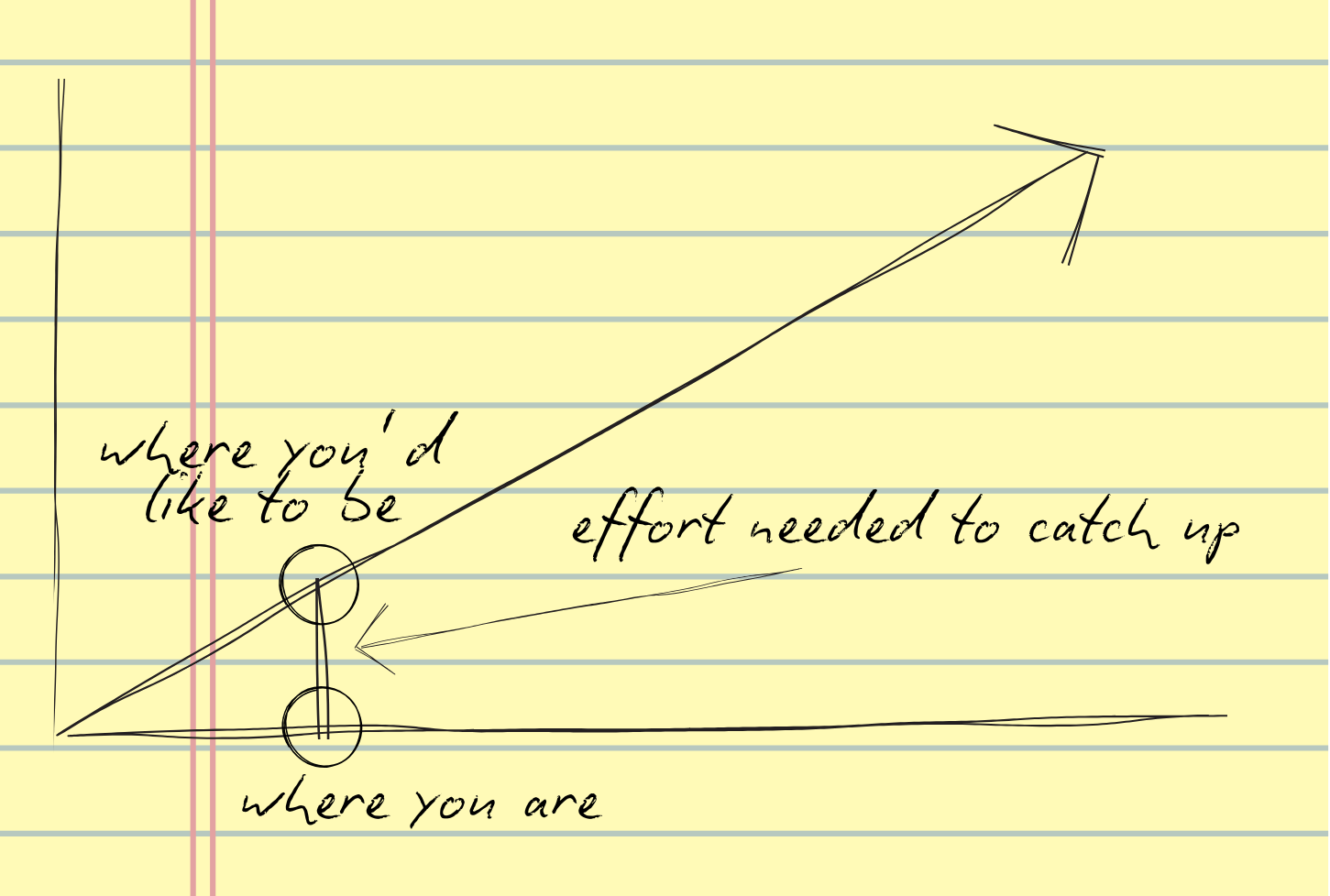
For most of us, a gap exists.
If we genuinely want to raise independent kids, the work needs to be done.
And ignoring it doesn’t make it any smaller.
Yet, most of us weren’t taught how to let go and stay connected with our kids. So we’ve been improvising. Over-functioning. Hoping it works itself out.
But clarity doesn’t come from hoping.
It comes from deciding to lead—on purpose, even when we’re late.
Or it’s hard. Or we’re scared the realignment might break something.
The truth? Something might break.
But not more than what’s already breaking by staying stuck in a dynamic that no longer serves parent or child.
And maybe that’s the point.
The version of the relationship that’s no longer beneficial should be dismantled, so something more deliberate and lasting can take its place.
Avoidance Has a Curriculum
It’s no secret our kids are constantly learning from us, but this is especially true in the moments we think don’t count.
When we regularly delay tackling challenges, they don’t see it as pause—they see it as pattern.
Kids don’t calibrate to what we hope they absorb.
They calibrate to what we repeatedly do.
And every time we dodge or procrastinate or buffer, we’re not just preserving our short-term peace. We’re shaping their long-term perception.
So they learn that discomfort is better sidestepped.
Hard conversations can wait.
Avoidance is a valid strategy for staying safe.
And effort only kicks in when urgency does.
By the time we’re ready to lead differently, they’ve already drawn conclusions—not just about who we are and how we show up, but also how the world works and their role in it.
And now we’re not only asking them to do something new; we’re asking them to unlearn what we’ve shown them is normal.
The longer we delay what’s difficult, the more deeply ingrained the implicit lesson becomes:
Evasion is how grownups cope.
And that doesn’t just complicate their growth—it constrains their courage.
The Later We Wait, the Louder It Lands
When kids are young, boundaries feel like structure. Guidance lands as support. And early expectations offer them a chance to try, stretch, and grow.
But the older they get, the more meaning they assign to what we don’t ask of them, and what we keep doing instead.
Roles settle in. Patterns become the norm.
And when we finally change course—step back, raise the bar, stop rescuing—it doesn’t just feel different.
It feels personal.
Like the rules changed mid-game, and the belief in them came too late.
The child who’s used to being micromanaged now feels abandoned.
The teen sees newly raised expectations as punishment.
The adult child experiences recalibration as rejection.
And often, we’re surprised by how much it stings—for them and for us.
Sometimes we delay change because we know it will be hard on them.
But more often, we avoid it because it’s hard on us.
It forces us to question who we’ve been, especially if being needed has become an ingrained part of our identity.
We know how to protect. To patch. To fix.
We’re less practiced at standing back and letting them flail without wincing.
And even less practiced at trusting them to carry more than we’ve let them.
But neither their reaction nor our discomfort is failure.
It’s evidence the dynamic is shifting—on the inside, not just the surface.
What used to be routine is being redefined. And like any long-standing system, it resists change before it accepts it.
If the transition feels emotionally charged, it’s because we’re not just disrupting a habit; we’re renegotiating an emotional contract we didn’t consciously sign.
I’ll admit, I used to (internally) roll my eyes at that first diagram my dad would draw during his “motivational talk.” But the sketch that came next always made me sit up a little straighter because it made one thing painfully clear: