


I am not a nostalgic person. Anniversaries and milestones don’t hold much weight for me. Maybe it is the way my nervous system was wired by too many years in fight-or-flight. Maybe it’s the hustle that took over after that.
But this week always gets through my armor. It pulls at me in a way the rest of the year never does. I have been circling the reason for days, letting memories surface on their own terms.
Eleven years ago this week was the end of what I thought my life was supposed to be and the beginning of something I never saw coming. People imagine hope as a bright moment. Mine arrived inside withdrawal and stillness.
For two years, I moved through life medicated enough to function but not enough to be awake. It crept in quietly. A prescription after a surgery. More when the relief didn’t last. Then something stronger when life got heavy, and no bandwidth to question it. I was stretched thin, trying to keep our family image intact while my spirit kept getting knocked sideways.
And then one Thursday in late September, without planning or rehearsing, I heard myself tell my doctor I wanted off everything. I still don’t have a clue what pushed the words out: less of a decision, more like being steered.
Detox gutted me. The days slid past in a smear. The nights were worse. I spent those weeks shut away in my bedroom, too worn down to do anything but shake and sweat and endure. Every nerve ending burned while the rest of my body felt trapped in an ice bath that never warmed.
By the time Thanksgiving arrived, I was sober. Worn through. Unsteady on my feet. Empty in a way that felt strange then and holy now. I didn’t know it at the time, but that week—this week—was the hinge everything would turn on.
I’m not big on certainty, and my faith has never been tidy or traditional, but this part I know is true. When something bigger grabs you by the collar and turns you toward a door you had no plan to walk through, you remember it. You carry gratitude for it in a way that never fades. Because my girls needed a mother who could see straight—and everything that followed depended on it.
Getting clean was the prologue. There was a heavier story waiting for me, one I never could have walked through if I was still fogged by the thing that had kept me numb. That season didn’t just pull me out of addiction. It rebuilt my life. It changed the course of my daughters’ lives, too. It cleared the ground for the three of us to build something fuller and freer than anything we could have dreamt of.
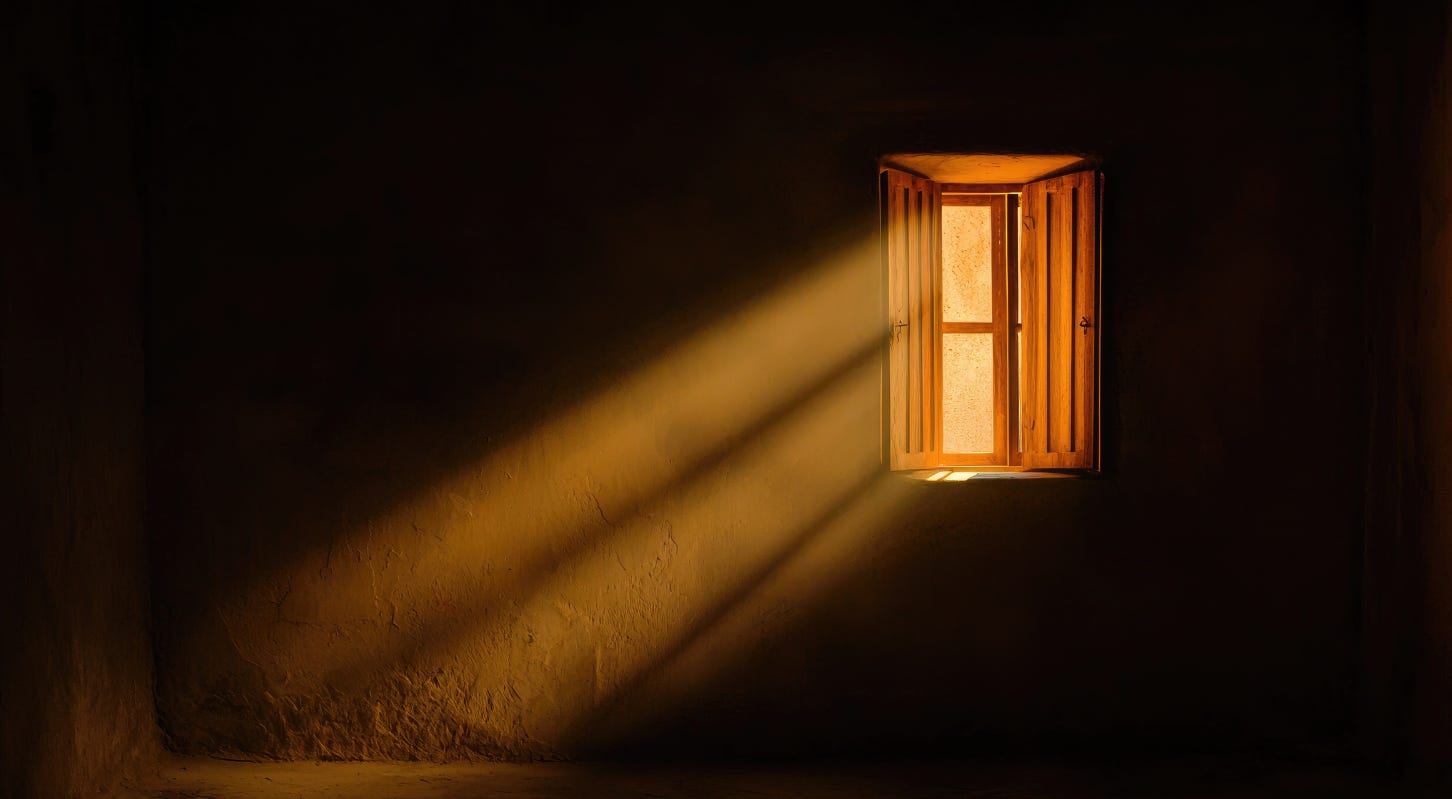
So when I say hope begins in the dark, I am not speaking in metaphor. I learned it in a room where the curtains stayed closed and the world felt painfully far away.
Eleven years ago, I crawled out of bed, pulled on a bathrobe, and sat at the table picking at a Thanksgiving meal I barely remember. No pretense. No performance. No old beliefs to hide behind. Just me. And even though I couldn’t feel it yet, the first embers of hope were already starting to glow.
I needed strength for battles I had avoided. Courage for truths I had kept locked behind my teeth. And release from the grip of a man who loathed me but refused to let me go. Hope didn’t come dressed like salvation. It came when I could barely lift my fork.
People think hope is something you have to see. Something you can touch or measure. But most of the time it’s born in moments we’re clueless to. It hides in the pause between descent and rising. It flickers in the dark long before we recognize its light. Only hindsight teaches us how sacred the unseen really was.
Years earlier, a dear friend gave me a watercolor postcard I carried everywhere—in my purse, as a bookmark, taped to my mirror when I needed it most. On it was a line by Anne Lamott:
“Hope begins in the dark, the stubborn hope that if you just show up and try to do the right thing, the dawn will come.”
I lived that long before I understood it.
To the one who feels buried right now, who thinks the hole is too deep or too dim, I offer my story as proof. Not because I know the answers. I do not. But because I remember what it feels like to believe there aren’t any.
Hope rarely feels like hope while it’s forming. But it’s working. Quietly. Stubbornly. And one day you’ll look back and see the dark for what it was—the beginning.
This piece carries so much tenderness, and I keep noticing how easy it would be to rush past that. The choice to step away from the prescription wasn’t a small pivot. It struck me as one of those rare moments when you know something in you has shifted, even if you can’t explain what stirred it. The choice was real, and you felt its weight right then, even as the reasons stayed just out of reach. There’s a power in that kind of clarity that arrives without a trail.
But there’s more pulsing underneath it. The way you tell it hints at the deeper story running alongside the decision. The loneliness of those weeks. The cost of holding yourself together for your girls. The quiet strength it takes to walk through withdrawal while still showing up for a life that hadn’t softened yet. That part feels just as alive as the moment you chose to get clean. Maybe even more so.
I find myself wanting to sit with all of it. The tenderness, yes, but also the grit and the ache and the strange holiness of rebuilding yourself in a room where the curtains stayed closed. It’s rare to see someone write about that season without smoothing the edges. You let it stay raw. And the fullness of it is what makes the hope inside your story land the way it does. Thank you for sharing all of it. The beauty. The edges.
Erin, thank you for sharing yourself so generously and so beautifully. In the serendipitous way of such things, your story is one I needed to read today, both for me and for a family member who is struggling to find light and hope in the darkness. I'm so grateful to your courage, your honesty, and your decision on that long-ago Thanksgiving to live your life openly, freely, and authentically. We are all better for it.